 GPT Researcher
Say goodbye to
hours of research
An open source agent that researches the web and your own documents, then writes a detailed report with citations.
Helping teams at












Open source since 2023
The #1 Open Deep Research Agent
Downloaded millions of times and shaped by hundreds of contributors. Ask a question, and it plans the research, reads sources in parallel, and writes a cited report, using the LLM and search engine of your choice.
$ pip install gpt-researcher$ git clone https://github.com/assafelovic/gptr-mcpPython 3.11+from gpt_researcher import GPTResearcher
query = "why is Nvidia stock going up?"
researcher = GPTResearcher(query=query)
# Conduct research on the given query
research_result = await researcher.conduct_research()
# Write the report
report = await researcher.write_report()
# report outputs as markdown, PDF, docx, string and more!{
"mcpServers": {
"gptr-mcp": {
"command": "python",
"args": ["/absolute/path/to/gptr-mcp/server.py"],
"env": {
"OPENAI_API_KEY": "your-openai-key",
"TAVILY_API_KEY": "your-tavily-key"
}
}
}
}Exposes deep_research, quick_search, write_report, get_research_sources and get_research_context to Claude, Cursor, n8n and any MCP client.
Architecture
A research team in a single call
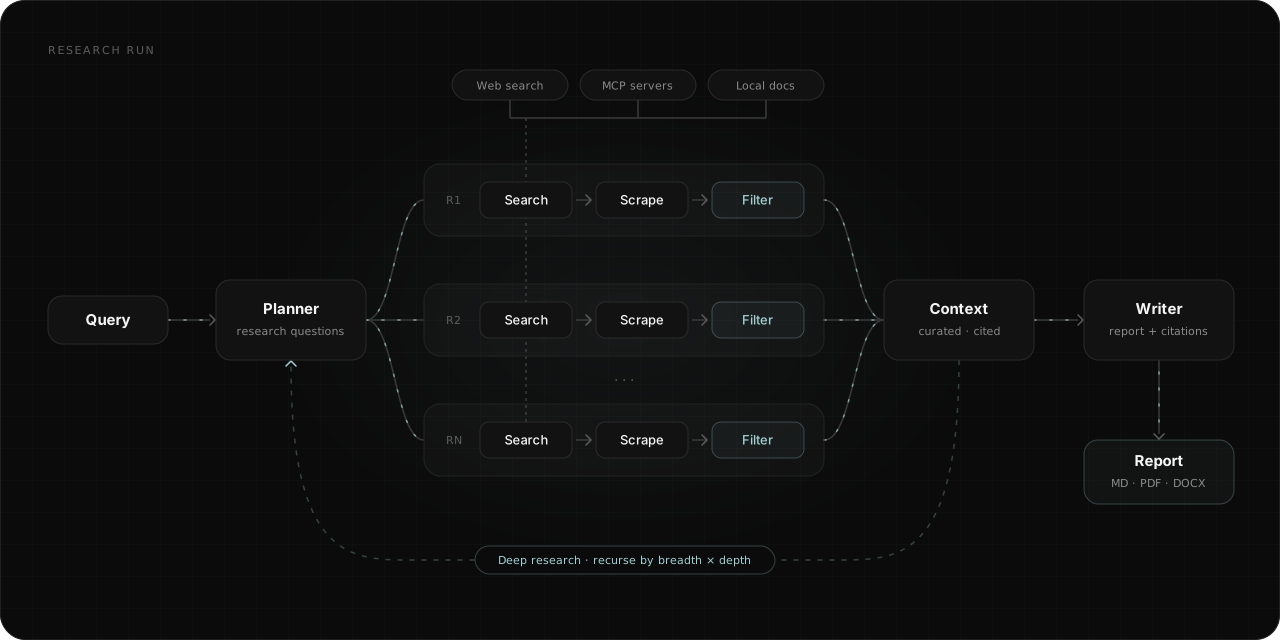
A planner splits your question, researchers work through it in parallel, and only the passages that matter reach the writer. Every claim in the report traces back to a source.
Scroll to see the full diagram
Parallel researchers
The planner writes a set of research questions and runs a researcher for each one at the same time.
MAX_ITERATIONS=320+ retrievers
Tavily, Google, Bing, Exa, arXiv, PubMed and more, combined with any MCP server or your own documents.
RETRIEVER=tavily,mcpContext filtering
Jev, BM25 or embeddings keep only the passages that answer the question, before anything reaches the LLM.
CONTEXT_FILTER=autoDeep research
Findings seed new questions, so a run explores a tree of subtopics instead of a single pass.
DEEP_RESEARCH_DEPTH=2
Context filter benchmark
Jev's context is 59% more relevant than embeddings, at the same cost
GPT Researcher filters sources with Jev by default, and falls back to local keyword ranking when no TypeSafe key is set, so no key or embeddings provider is required.
Read the benchmark- Jev73%
- Keyword51%
- Embeddings46%
Relevant passages kept · 28 research tasks · same scraped sources
Configurable
Tailored just for you
Shape every aspect of research, from input to output.
Support for all LLMs
Easily connect any LLM of your choice from OpenAI, Anthropic, Groq to Llama 3 and HF.
Use any Search Engine
Conduct research with any search engine from Google, Bing to Tavily and DuckDuckGo.
Research Local documents
You can also search through your local documents and files and also conduct hybrid research using both local and web sources!
Generate Long Reports
GPT Researcher breaks the LLM token limit to generate longer reports (2K+ words).
Export to any Format
Export your research to any format from PDF, Word, Markdown to JSON and CSV.
Multi Agent Support
Add GPT Researcher to a team of agents to collaborate on research.
Benchmarks
Ranked #1 in Academic Benchmarks
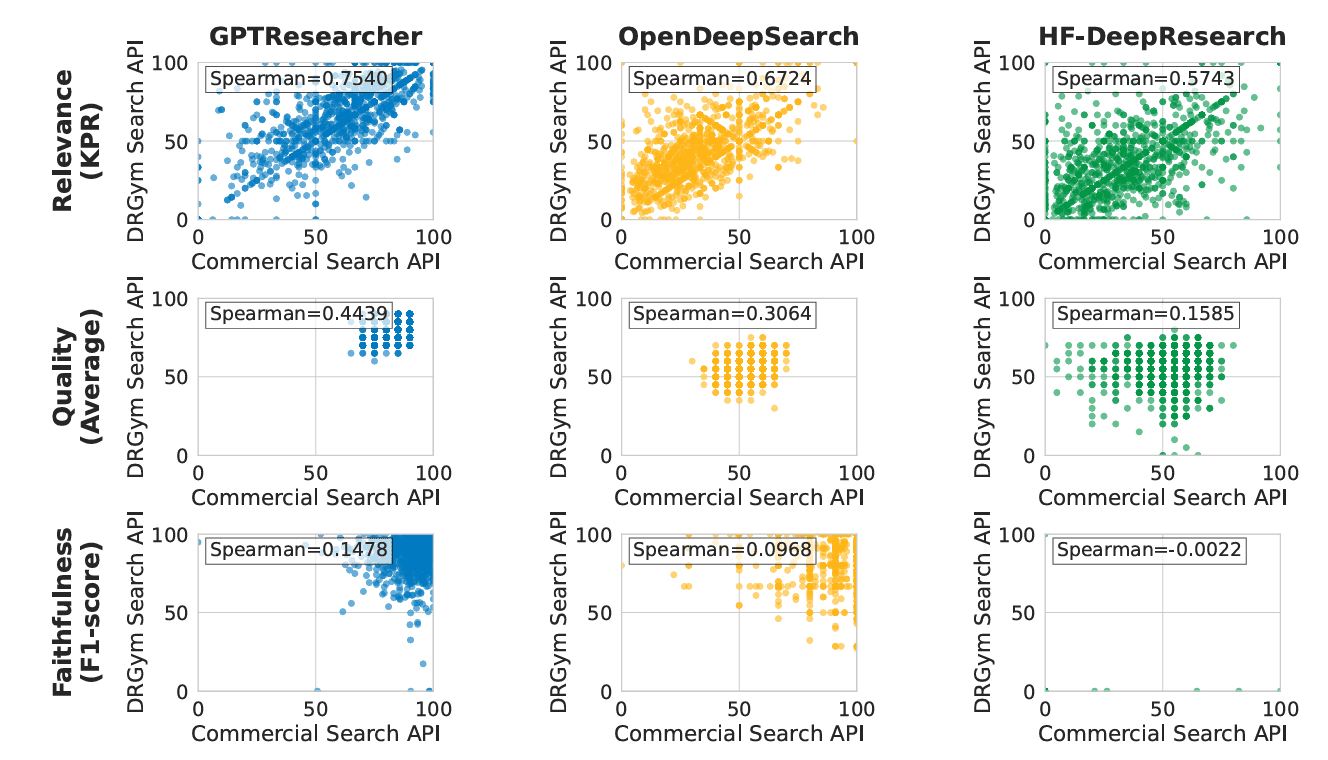
Carnegie Mellon University's DeepResearchGym (May 2025) evaluated leading deep research systems on 1,000 complex queries. GPT Researcher outperformed Perplexity, OpenAI, OpenDeepSearch, and HuggingFace, achieving the highest scores in citation quality, report quality, and information coverage.
Citation Quality
#1Only system >85% on both
Report Quality
#1Highest in both dimensions
Coverage
#1Highest coverage
Research
Academic Citations
GPT Researcher has been cited in numerous academic papers and research studies.
Deep Research Comparator: A Platform For Fine-grained Human Annotations of Deep Research Agents
Prahaladh Chandrahasan, Jiahe Jin, Zhihan Zhang et al.
Deep Researcher with Test-Time Diffusion
Rujun Han, Yanfei Chen, Zoey CuiZhu et al.
DeepResearchGym: A Free, Transparent, and Reproducible Evaluation Sandbox for Deep Research
João Coelho, Jingjie Ning, Jingyuan He et al.
HLTCOE at LiveRAG: GPT-Researcher using ColBERT retrieval
Kevin Duh, Eugene Yang, Orion Weller et al.
Chain of Ideas: Revolutionizing Research in Novel Idea Development with LLM Agents
Long Li, Weiwen Xu, Jiayan Guo et al.
BioKGBench: A Knowledge Graph Checking Benchmark of AI Agent for Biomedical Science
Xinna Lin, Siqi Ma, Junjie Shan et al.
Community
Join the Fast Growing Community
Our mission is to empower individuals and organizations with accurate, unbiased, and factual information. Join our community and help democratize automated AI research.
Testimonials
What People Are Saying
What is GPT Researcher?
GPT Researcher is an open source autonomous AI research agent that gathers and validates information from multiple web sources in parallel, then writes a detailed research report with inline citations. It supports any LLM (OpenAI, Anthropic, Google, Mistral, DeepSeek, local via Ollama) and any retriever (Tavily, Bing, Google, DuckDuckGo, SearXNG).
How do I use GPT Researcher with Claude or ChatGPT?
Use the official gptr-mcp Model Context Protocol server (github.com/assafelovic/gptr-mcp). It registers as an MCP server in Claude Desktop, Cursor, ChatGPT custom GPTs, n8n, and any client that supports MCP, and exposes tools like deep_research, quick_search, and write_report.
Is GPT Researcher free?
Yes. GPT Researcher is MIT licensed and free to use. The only operating cost is whatever you pay your underlying LLM and search API providers.
How does GPT Researcher compare to Perplexity or OpenAI Deep Research?
GPT Researcher ranked #1 on Carnegie Mellon University's DeepResearchGym benchmark (May 2025), ahead of Perplexity Deep Research and OpenAI Deep Research. Unlike those products, GPT Researcher is open source: you control the LLM, the retriever, and the deployment.
How do I host GPT Researcher myself?
Install the Python package with pip install gpt-researcher and call it from your code, or clone the repository and run the FastAPI server (python -m uvicorn main:app) or the Docker image. The server's endpoints are described at gptr.dev/openapi.json.
Can GPT Researcher research my own documents?
Yes. Point it at local files to research them directly, or run hybrid research that combines your documents with web sources in a single report.
What do I need to run it?
Python 3.11+, an LLM API key (for example OPENAI_API_KEY) and a retriever API key (for example TAVILY_API_KEY). Swap in any supported provider through environment variables, including local models via Ollama.

Built in the open by researchers and engineers worldwide
Shaped by hundreds of open source contributors, cited in academic research, and used by teams at Google, NVIDIA, Stanford and more. Star the repo or join the community to help build what comes next.